Tuesday, April 21, 2009

My Boy

Men have not often come in a manlier package than the rugged actor/singer Richard Harris. A rowdy, occasionally boozy sort with a wicked flair for dramatics, Harris could invest himself fully in almost anything.

He was a walking firebomb in the angry-young-man British feature This Sporting Life playing a tough rugby star, and a more subdued sort in the Italian drama The Red Desert.

Prized by myself amongst his many acting roles is Harris’ portrayal of Captain Nolan, the fisherman unwilling to fight back at a vengeance-thirsty killer whale in the Jaws-inspired debacle that is Orca. It was filmed in the small fishing community of Petty Harbour, featuring actors making no real effort to come-off as authentic outport Newfoundlanders. And the whale blows up sheds! It’s a riot.

The musical career of Harris is commonly scorned as the byproduct of a vanity project devoid of any true value, beyond his insanely strange and enjoyable epic hit “MacArthur Park.”

His music’s appeal tends to rely heavily on kitsch value, which isn’t really a bad thing when you’re talking about a professionally made product lifted by a unique vocal presence. Harris had the latter in spades with his quivering, ragging bellow of a voice.

The Richard Harris Love Album collected a number of his more romantic moments for the Dunhill label, which includes his “MacArthur Park” era material. “What a Lot of Flowers” was a single released in 1969, the year after “MacArthur Park” hit big. This tune never reached the near-chart-topping heights of his most well loved number, which is a shame, because it deserves more.

Written by Leslie Bricusse and produced by Johnny Harris (who also worked with Shirley Bassey, Petula Clark, and Tom Jones), “Flowers” is a top-notch, loungy pop song with an air of engaging ridiculousness.

The opening piano riff is a catchy starting point to warm up the listener for Harris’ swooping vocals, which get straight to the heart of the matter.

“What a lot of flowwwwwwweeeeeeerrrrrrrsssss. What a lot of sunnnnnnssshhhiiiinnnneeeee.”

Indeed Richard, there must be a lot of flowers, sunshine, and “music in the world today.” From there, he expresses his admiration for the many colours of the rainbow, and how they spread themselves through a cluster of flowers.

He gets excited about this, belting out the refrain of “VIOLETS! VIOLETS! VIOLETS!” several times before calming down again. It’s a particularly grand sort of flower, I reckon. The mellow conclusion is a nicely arranged coda, with reverberating woodwinds creating an almost spacey ambiance combined with Harris’ typically quivery voice.


A mixtape favourite of mine for a number of years now, “What a Lot of Flowers” is a song that’s hard to ignore while it plays. The forcefulness of Harris’ performance will grab you – maybe in a night-stalkerish way, hopefully though in a more suave-party-host fashion.

Richard Harris - "What a Lot of Flowers"

Thursday, March 5, 2009

Wow and Flutter

Electronic artist Daedelus (or Alfred Darlington) takes an anything goes approach with his music. One moment he could be laying down a hard beat for an MC like MF Doom to spit rhymes over, the next he could bring a lovely psychedelic pop ditty or something aimed strictly at the dance floor. Generally, don’t expect one of his albums to dwell too much on one side of his varied persona.

He’s an inventive soul, which fits his chosen namesake given Daedelus is known as an inventor in Greek mythology. This could be taken as a brazen ego-stroking move on his part, but Daedelus’ music backs him up admirably.

The productions on his most recent album for Ninja Tunes, 2008’s Love To Make Music To, is typical in its try-anything style. There’s your slow-burning grooves followed by bouncy up-tempo numbers before moving on to who knows what. It took me some time to appreciate the album to its fullest, but I’m now inclined to say it’s one of my favourites of last year.

The hottest jam title for Love To Make Music To is owned by a slightly repetitive yet incredibly infectious song. “Make It So” was the first single off the album, which I didn’t realize until writing this post. Whoever made the call has got solid pop instincts.

Featuring the vocals of Michael Johnson – not to be confused with the American track star (I assume?) – “Make It So” sounds like a sunny, long lost New Order track. The lyrics concern a souring relationship where hope remains for some sort of reconciliation. Daedelus’ production work latches onto the hopeful nature of the song and builds lots of momentum, adding layer upon layer of synth-tastic wonder alongside a merry beat.

Musically, it’s highly romantic sounding; it literally makes me want to love every single woman on Earth. As this is impossible, I’ve lately settled on just listening to “Make It So” excessively. Once its effect wears off, I’ll have to scour the Internet for a 12-inch copy of New Order’s “The Perfect Kiss” single. Then I'll continue to swoon.

Monday, February 23, 2009

Taking Drug to Make Music to Take Drugs to ...

Spacemen 3 were part of the noisy aftermath of the post-punk era, the segment that relied more on screechy guitars rather than drum machines and synths. Like their adventurous British contemporaries of the day, the Jesus and Mary Chain, the group was eager to place heavy guitar feedback within song-based material.

Yet where the Reid brothers of Psychocandy fame worshiped Brian Wilson and concise punk rock, head Spacemen Jason Pierce and Sonic Boom had a hard-on for dirty garage rock and stretched out, droning jams.

The first album from this Rugby, England band, 1986’s Sound of Confusion, displays most of their best traits, which would become further refined on later releases like Playing With Fire. Pierce’s voice sounds like he’s just gotten out of bed after a night of chemically induced highs. The music buzzes, fuzzes and plods with a spacey sense of purpose.

Album closer “O.D. Catastrophe” may not be the easiest song to appreciate compared to catchier – and shorter – tunes like “Losing Touch With My Mind” and “2.35.” However, it serves well as a call-to-arms for droneheads and those who want to immerse themselves in musical trips.

This song is not recommended to serve as background music. To get the full effect, it should be played really loud. Sit on your couch, unbutton your jeans for maximized comfort and just let the song hit you.

It starts with the simple one-chord non-progression; a powerful and appropriately fuzzed-out drone complemented by a bass tom, sporadic cymbal crashes, and firmly anchored bass. The approach to singing by Pierce strongly recalls The Stooges’ “TV Eye” (they also cover “Little Doll” on the album) as he spells out the nature of this doom-tinged apocalyptic trip.

Momentum builds for the insertion of Sonic Boom’s flowing feedback, which isn’t as abrasive as one might expect. It ebbs in and out of the recording, colouring the proceedings while leaving the heavy lifting to the rest of the group. Nearly nine minutes in length, it’s a powerful recording hinting at future glories.

Spacemen 3 - O.D. Catastrophe

Monday, February 2, 2009

Horn on a Hill


Sonny Simmons was an alto saxophonist who achieved some success within the free jazz scene of the '60s and early '70s, largely due to the fluid intensity he brought to almost every single solo he played. In an age where tenor saxophonists tended to get the most recognition, Simmons excelled playing the alto and managed to play with some big names, including Charles Mingus, Eric Dolphy, Elvin Jones and Jimmy Garrison.

Sadly, the approval of his peers did not translate into a viable living, leading him to disappear for 20 years. He occasionally contributed to soul and funk recordings and even spent some time playing for change on street corners. Miraculously, he made a comeback in the 1990s, and even in his mid-seventies Simmons continues to record and perform.

Without knowing a thing about this guy, I bought Simmons' first LP for ESP-Disk - 1966's Staying On the Watch - for a sweet price at Fred's Records in St. John's. The cover was what initially attracted me to buying this album, a stark and powerful image of the man and his horn. He looks like he's the king of New York, or at the least the coolest motherfucker standing on a rock with a saxophone ever.

"Metamorphosis" is a blazing album opener, starting with a theme based around a fierce flurry of notes that's followed by several sustained blasting bleeps. Then we get to Sonny's solo, a complex series of howls, screeches and atonal blasts. It's a mind blowing performance, marvelously intense.

Simmons' wife Barbara Donald (a rarity being a female jazz instrumentalist who doesn't play piano) is up next. Her playing here is expressive and spirited, reaching for notes high and low while keeping up with the brisk pace set by the rhythm section. Bassist Teddy Smith takes a fine bowed solo to set-up a flashy showcase for pianist John Hicks, who vamps with hard-bop flair and even gets in some intricate licks that recall Cecil Taylor's improvisations.

Then it's a quick return to the opening theme and that's all she wrote. Eleven minutes of great free jazz from an era that produced lots of it.

Sonny Simmons - Metamorphosis

Monday, January 26, 2009

Argentina's Talent Bank Not Bankrupt


There are benefits to being a disc-jockey on campus-community radio that go beyond the mildly delusional notion of being cool within a fairly geeky setting. While wading through lots of music you would hope didn't exist, you're also bound to come across some true gems you'd otherwise never hear.

So is the case with my discovery of Juana Molina, a charming singer-songwriter from Argentina with a neat background to boot. Before she ever started releasing music, Molina was actually a pretty big television star in her homeland, appearing in various comedy programs.

Somewhere down the line I guess she got tired of that gig and decided she'd rather make otherworldly space-folk with a serious flare for atmospherics. Her music relies heavily on the looping of her voice and acoustic guitar sprinkled with quirky electronic flourishes. It's like a stripped-down Bjork, minus the hype and swan dresses.

Her 2006 effort Son introduced me to her sound, plucked off the shelves of CHMR-FM in St. John's, Newfoundland. I guess the cover art was what initially drew me in (being released on a decent label like Domino Records helps matters too). As you can see here, it's very pretty.

The album's second track, "Yo No," is as good a point of introduction as you'll find on Son. It opens quietly, with just Molina's voice and some woozy keyboard noises accompanying her vocal lead. Eventually her voice travels in a spooky fashion, panning and swooping endlessly from left to right before light percussion enters the picture. Another verse begins and eventually gives way to a trippy breakdown before the track moves towards its conclusion.

The mix makes it a great headphones song with its inventive use of the left and right channels, where all parts float back and forth. Based on experience, her music also seems well suited to mixtapes for girlfriends. Likewise, nerdy guys such as myself should appreciate her inclusion on a lovingly crafted cassette mix.

"Juana Molina - Yo No"

Monday, January 19, 2009

Disco Balls on Hold


Once upon a time marijuana was more popular at dance clubs than cocaine, the term British Invasion didn't reference The Bay City Rollers, and Australia's Bee Gees had yet to release the most popular movie soundtrack of all time.

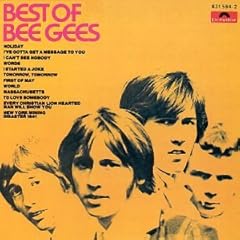
It will always remain near impossible for people to not instantly think of a young sexy pre-Scientology John Travolta striking an exaggerated dance pose on a glittering floor when someone mentions the name Bee Gees. I was in the same boat until I came across a free copy - through one of my dad's retired teacher friends - of the early hits compilation Best of Bee Gees.

With a plethora of sophisticated pop songs, this collection shows that more than anything, the Bee Gees were a group prepared to swing with the times. Lord knows they would've been a musical afterthought if they hadn't gone on to reinvent themselves in the mid-'70s as chest hair pimping disco kings.

Far and away the most bizarre track on the album, "Every Christian Lion Hearted Man Will Show You" is a hard psychedelic pop nugget that sounds more Beatlesy and less Boney M.-ish. It opens with what I figure is some sort of Latin chant ("Oh solo Dominique") before moving into a lilting verse with lush harmonies backed by a booming psychedelic rhythm. The chorus, which simply repeats the title over and over, is jubilant and joyful. A great song from an unexpected place.

"Bee Gees - Every Christian Lion Heart Man Will Show You"